
What is my business worth? How buyers actually price a small business in 2026
Buyers don't pay for revenue or for what you've put in. They pay a multiple of earnings they believe will continue. Here is how that works, what the market is paying now, and how to raise both numbers.

Updated · 3 min read
- Most small businesses sell for a multiple of earnings: SDE for owner-run businesses, adjusted EBITDA for larger ones.
- In Q3 2026, BizBuySell reported average cash-flow multiples of 2.30x for sales under $1 million and 3.73x above.
- The earnings number matters as much as the multiple, and buyers will test it in a Quality of Earnings.
- Recurring revenue, low customer concentration, clean books and a business that runs without you all raise the multiple.
- Online calculators give a rough range; a sale, an SBA loan or an estate needs a formal valuation or a QoE-backed number.
The basic formula
Value = earnings buyers believe × the multiple your risk deserves. Then the deal adjusts for working capital, debt and anything else that comes with the business.
- Seller's discretionary earnings (SDE) is used for owner-run businesses: pre-tax profit plus one owner's full pay and perks, interest, depreciation and one-time items. See SDE vs. adjusted EBITDA.
- Adjusted EBITDA is used once the business has management in place, usually above about $1 million in earnings. It deducts a market salary for the CEO role.
What the market is paying now
According to the BizBuySell Insight Report, which tracks U.S. small business sales, the third quarter of 2026 saw a median sale price of $350,000 and average cash-flow multiples of 2.30x for businesses selling under $1 million and 3.73x for those above (summary). In the second quarter the market-wide average was 2.7x cash flow and 0.7x revenue.
| Business size | Typical earnings measure | Typical multiple range |
|---|---|---|
| Main Street, sale under $1M | SDE | about 2x to 3x |
| Sale $1M to $5M | SDE or adjusted EBITDA | about 3x to 4.5x |
| Lower middle market, $1M+ EBITDA | Adjusted EBITDA | about 4x to 7x, higher in favored industries |
Rough ranges for illustration, informed by the BizBuySell data above; industry, growth and risk move these considerably. Not a valuation.
What raises or lowers your multiple
| Raises the multiple | Lowers the multiple |
|---|---|
| Recurring or contracted revenue | One-off project revenue |
| No customer over 10% of sales | One customer at 30% or more |
| A team that runs the business without you | Every relationship runs through the owner |
| Accrual books that tie to tax returns | Cash-basis books, add-backs without support |
| Steady or growing margins | Declining margins or a recent spike |
| Documented processes and systems | Knowledge in one person's head |
The number that gets multiplied matters as much
A 3.5x multiple on $800,000 of SDE is $2.8 million. If a buyer's Quality of Earnings removes $150,000 of unsupported add-backs, the same multiple gives $2.275 million: a $525,000 swing before anyone argues about the multiple. That's why we recommend owners test their own earnings first with a sell-side QoE, and document every add-back. See which owner's salary add-backs survive diligence.
Getting a defensible number
- Rough range: an online calculator or our add-back calculator and exit readiness score.
- Earnings you can defend: a sell-side QoE or a pre-sale earnings review.
- A formal valuation: from a credentialed business appraiser when you need one for an SBA loan, an estate or gift, a buy-sell agreement or a partner buyout. We work alongside appraisers and refer clients to them; StrategX doesn't issue valuation opinions.
- A plan to raise it: exit planning works on the drivers above, usually over one to three years.
Want to know what a buyer will believe?
A sell-side QoE tests your earnings before a buyer does. Exit planning works on the multiple.
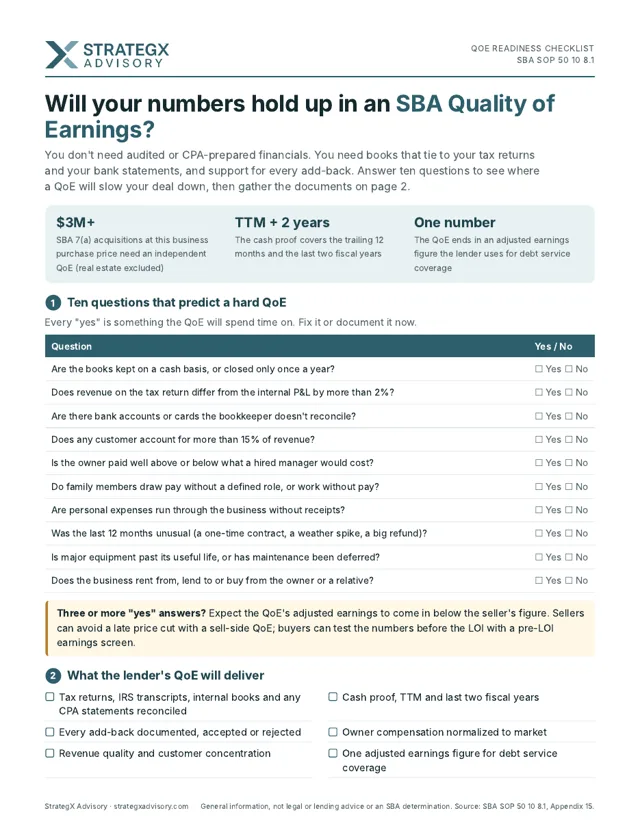
The SBA QoE Readiness Checklist
Two pages: ten questions that show where your numbers won't hold up, the documents a QoE needs (no CPA-prepared financials required), and the timeline. For buyers, sellers and lenders on 7(a) deals of $3M or more.
Frequently asked questions
How is a small business valued?
Most small businesses are valued as a multiple of earnings: SDE for owner-run businesses or adjusted EBITDA for larger ones, adjusted for working capital and debt. Asset-heavy or unprofitable businesses may be valued on assets instead.
What multiple will my business sell for?
In Q3 2026 BizBuySell reported average cash-flow multiples of 2.30x for sales under $1 million and 3.73x above. Your multiple depends on industry, size, growth, customer concentration and how dependent the business is on you.
Is a business worth a multiple of revenue?
Rarely for small businesses. Revenue multiples are used as a cross-check or in some recurring-revenue businesses such as SaaS; earnings drive most offers.
Do I need a formal valuation to sell?
Not always. Many sales are priced by the market. An SBA-financed sale, an estate or gift, or a partner buyout often requires a formal valuation from a credentialed appraiser.
How can I increase what my business is worth?
Raise the earnings buyers will believe (clean books, documented add-backs, better margins) and reduce risk (recurring revenue, less customer concentration, a team that runs without you).
Edwin van Stam, CPA, CEPA, CGMA, founded StrategX Advisory in Salt Lake City. He started in audit at Tanner LLC, led accounting and assurance at Cook Martin Poulson, and has spent 20 years in audit, controller and CFO roles and transaction work, advising buyers, sellers and lenders on private-company acquisitions. More about Edwin →
Found this useful? Share it on LinkedIn. This article is general information, not legal, tax, or lending advice, and not an SBA determination.