
The net working capital peg, explained: the number that quietly changes your price
Most purchase agreements require the seller to leave a normal level of working capital in the business. Set the target wrong and the price changes at closing, dollar for dollar.

Updated · 3 min read
- The peg is the level of working capital the buyer expects to receive at closing.
- If actual working capital at closing is below the peg, the price usually drops by the shortfall; above it, it usually rises.
- Pegs are usually based on a trailing 12-month average, adjusted for seasonality and one-time items.
- Cash and debt are usually excluded; what counts is negotiated in the purchase agreement.
- A QoE calculates the peg from monthly balance sheets, which is why accurate monthly closes matter.
What the peg is
Net working capital is, in most deals, current operating assets (receivables, inventory, prepaids) minus current operating liabilities (payables, accruals, customer deposits). The peg is the target level both sides agree the business needs to operate normally. At closing, actual working capital is compared to the peg and the purchase price is adjusted for the difference.
A simple example
| $000s | Amount |
|---|---|
| Agreed purchase price (cash-free, debt-free) | 6,000 |
| Working capital peg (12-month average) | 900 |
| Actual working capital delivered at closing | 780 |
| Shortfall deducted from price | (120) |
| Adjusted price | 5,880 |
Illustrative figures.
The seller who let receivables run down or stretched payables right before closing pays for it here.
How the peg is set
- Average, not a snapshot: usually a trailing 12-month average of month-end balances, so seasonal swings even out.
- Seasonality: for seasonal businesses (landscaping, retail, construction) the parties may use the same month of prior years or a seasonal schedule.
- Normalization: one-time items, related-party balances and accounting errors are removed first.
- Definitions: which accounts are in or out is negotiated and written into the purchase agreement. Cash, debt and income taxes are commonly excluded.
Where sellers get caught
- Year-end-only accrual entries, so monthly balances are wrong and the average is too.
- Customer deposits and deferred revenue treated as revenue instead of liabilities.
- Inventory not counted or costed monthly.
- A peg proposed off a single strong month rather than an average.
Each of these is a reason to have accurate monthly closes for at least a year before selling.
How a QoE handles it
A Quality of Earnings rebuilds working capital month by month, adjusts for normalization items, and proposes a peg with the support behind it. Our net working capital analysis is a $3,500 add-on to any QoE. See fees.
Negotiating a working capital peg?
We build the monthly analysis and the support either side needs.
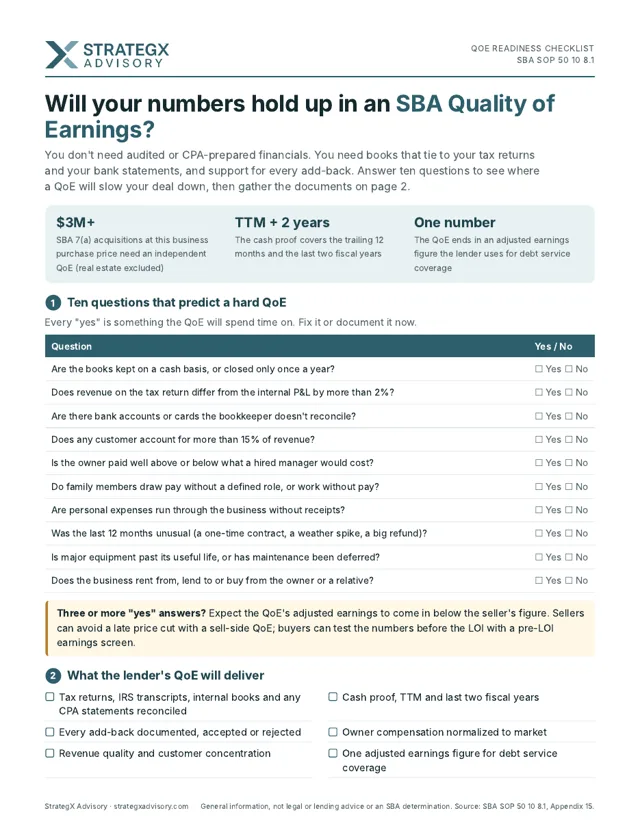
The SBA QoE Readiness Checklist
Two pages: ten questions that show where your numbers won't hold up, the documents a QoE needs (no CPA-prepared financials required), and the timeline. For buyers, sellers and lenders on 7(a) deals of $3M or more.
Frequently asked questions
Is cash included in working capital?
Usually not. Most deals are priced cash-free and debt-free, so cash and debt are excluded and handled separately. The purchase agreement decides.
Who sets the peg?
It is negotiated between buyer and seller, often based on the buyer's diligence or QoE. Sellers with their own analysis negotiate from a stronger position.
Does the peg apply to small deals?
Many smaller asset purchases transfer only specific assets and skip a peg, but working capital still affects what the buyer has to fund on day one.
When is the true-up done?
Usually an estimate at closing and a final true-up within 60 to 120 days after, as set in the purchase agreement.
Edwin van Stam, CPA, CEPA, CGMA, founded StrategX Advisory in Salt Lake City. He started in audit at Tanner LLC, led accounting and assurance at Cook Martin Poulson, and has spent 20 years in audit, controller and CFO roles and transaction work, advising buyers, sellers and lenders on private-company acquisitions. More about Edwin →
Found this useful? Share it on LinkedIn. This article is general information, not legal, tax, or lending advice, and not an SBA determination.