
Build a business a buyer will pay for, on your timeline
Most owners sell once. Exit planning is the work before that day: raising what the business is worth, making it run without you, and making sure the sale funds the life you want next.
Start a conversation Take the readiness scoreReply within one business day · Fixed fee in writing · No obligation
Most owners plan to exit soon. Few are ready.
of owners want to exit within ten years, and 49% within five.
of privately held companies are owned by baby boomers.
of baby boomer owners have a formal exit planning team.
of owners profoundly regret selling within a year of the sale.
Sources: Exit Planning Institute, 2023 National State of Owner Readiness Report, and 2025 generational State of Owner Readiness analysis. The regret figure is PwC research cited in the 2023 report.
Three kinds of readiness, planned together
A sale that is good on paper can still leave an owner short of money or adrift a year later. A complete plan covers the business, the owner, and the money, because each one changes the other two.
Business readiness
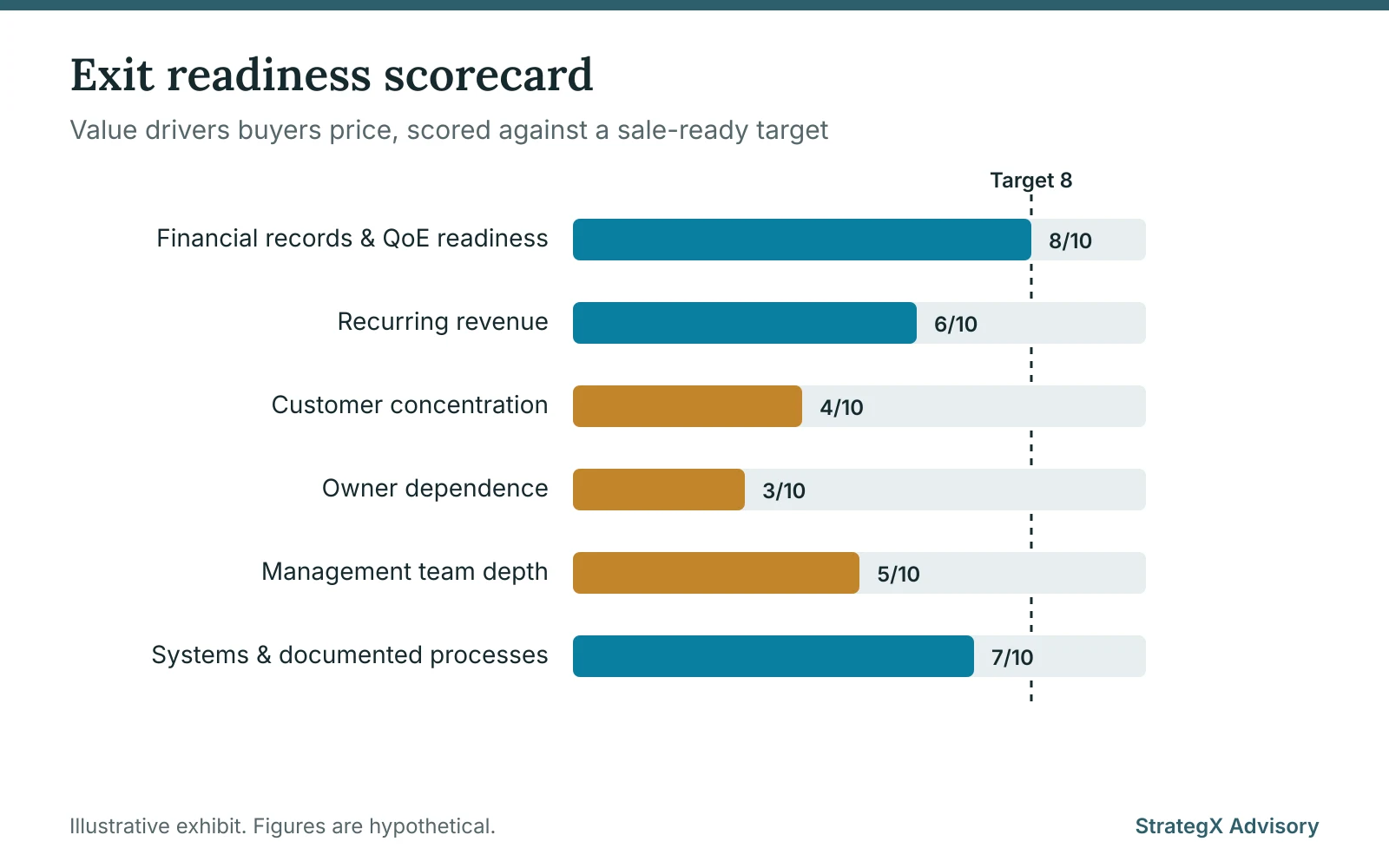
Could the company run, and keep its earnings, without you? We measure owner dependence, management depth, customer concentration, recurring revenue, documented systems, and the quality of the financials a buyer will test.
Personal readiness
What you are going to, not just what you are leaving. Your role after the sale, family and successor expectations, and the timeline that fits your life, so the decision is yours and not a reaction to an offer.
Financial readiness
Your number: what the sale has to net, after debt, taxes, and fees, to fund the life you want. The gap between that and today's value sets the agenda for everything else.
Close the value gap before you sell
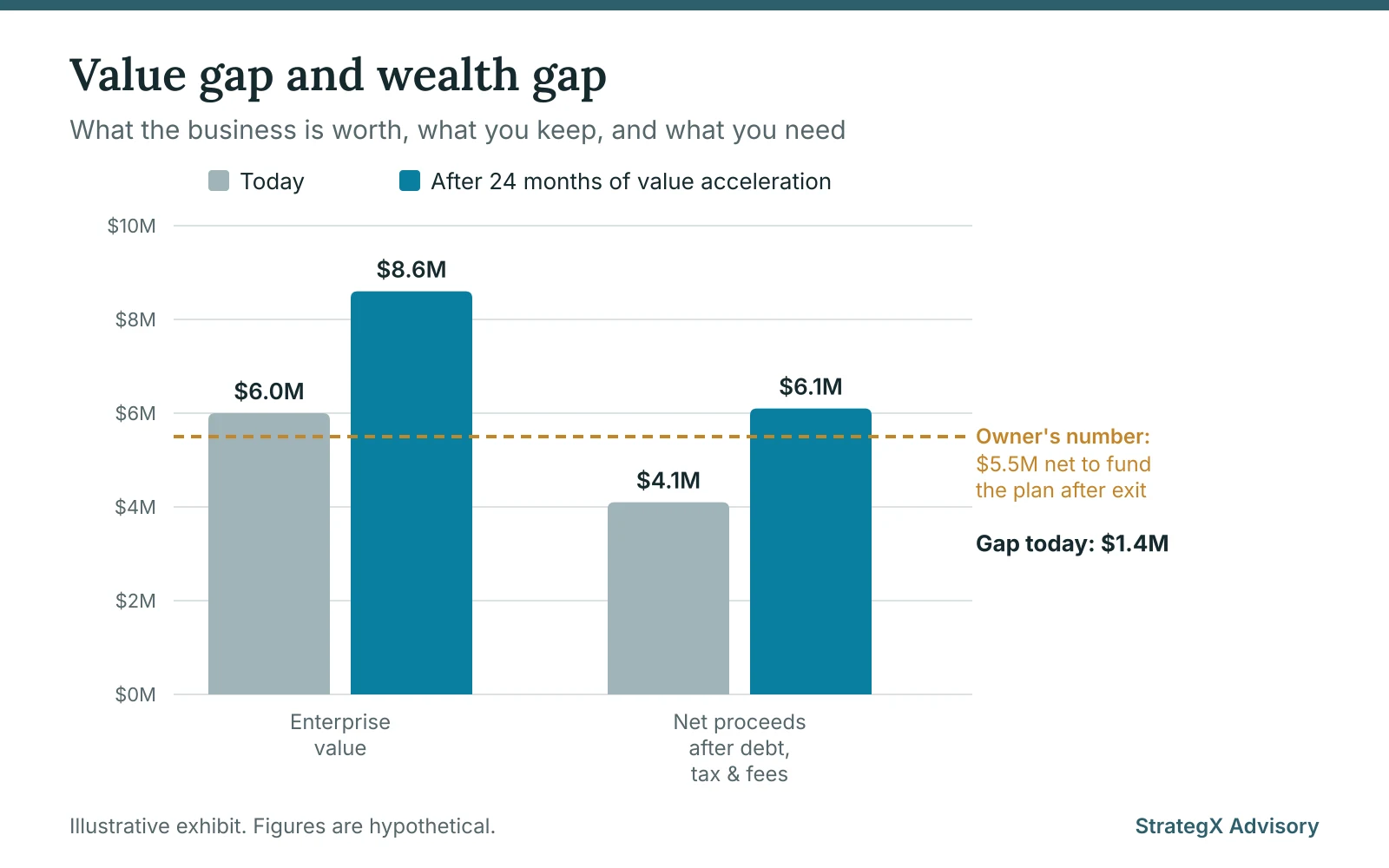
Most owners know roughly what they hope to get. Few know what the business would sell for today, what they would actually keep, or how far that is from what they need.
The assessment puts all three numbers side by side: indicative enterprise value from normalized earnings, estimated net proceeds after debt, taxes, and transaction costs, and your personal number. The gap tells us which value drivers to work on first and how long it should take.
Discover, prepare, decide
We follow the Exit Planning Institute's Value Acceleration Methodology™: build value first, then choose when and how to harvest it. Each stage has a defined deliverable and a fee in writing.
Exit readiness assessment
- Normalized earnings and indicative value range
- Value-driver scorecard against a sale-ready target
- Net proceeds and wealth-gap analysis
- Personal and timing goals
- Written roadmap ranked by value impact
Value acceleration
- Fix the issues that cost the most value first
- Reduce owner dependence and build the bench
- Monthly close and KPIs a buyer will trust
- Customer, contract, and pricing improvements
- Quarterly scorecard and value re-measurement
Sale readiness through close
- Choose the exit path and the timing
- Sell-side Quality of Earnings and add-back file
- Data room and diligence responses
- Broker or banker selection and coordination
- Working capital and closing-statement support
Your exit readiness report
The assessment ends in a written report and a working session, not a slide deck. Every number ties back to your financials, and every recommendation comes with an estimate of what it is worth.
Three readiness scores
Business, personal, and financial readiness, each scored 0 to 100 against a sale-ready benchmark, so you can see which one is holding you back.
Normalized earnings and value range
Adjusted EBITDA built the way a buyer's Quality of Earnings will test it, and an indicative value range from comparable transactions.
Value gap and wealth gap
What you would net today after debt, taxes, and fees, compared with your number, and the earnings and multiple needed to close the gap.
Top value levers, priced
The five changes most likely to raise value or reduce buyer risk, each with an estimated dollar impact, cost, and time to complete.
Deal-killer scan
The issues that cut offers or stall SBA financing: unsupported add-backs, cash that doesn't tie to the bank, customer concentration, and key-person risk.
90-day action plan
Owners, deadlines, and the first sprint. If you continue into value acceleration, we re-measure every quarter so you can watch value move.
Value lives in the intangibles
Two companies with the same EBITDA can sell for very different multiples. The difference is risk, and buyers price it through four kinds of intangible capital:
- Human: a leadership team and staff who can run the business without you
- Customer: recurring, diversified, contracted revenue
- Structural: documented systems, reliable financials, and protected IP
- Social: a culture and reputation that survive the transition
We score each one, show what it is costing you in value, and fix the weakest first.
Six ways out, and when each one fits
| Path | Usually fits when | Watch for |
|---|---|---|
| Strategic buyer | A competitor or adjacent company gains synergies and can pay for them | Earnouts, integration terms, and employee retention |
| Private equity | EBITDA is roughly $2M or more and there is a team to back | Rollover equity, the working capital peg, and a second sale later |
| Individual or search-fund buyer | The business is stable and SBA-financeable | SBA rules: an independent QoE is required on 7(a) deals of $3M or more |
| Management buyout | A capable team wants to own it | Financing, seller notes, and a fair price for both sides |
| ESOP | You want to reward employees, with tax advantages | Cost, complexity, and the required independent valuation |
| Family transfer | A successor is ready and willing | Fairness among heirs, gift and estate tax, and your own liquidity |
We help you compare paths on net proceeds, timing, and what matters to you. We coordinate the legal, tax, and valuation work with your attorney, CPA, and appraiser.
Exit planning from someone who tests earnings for a living
Most deals that fall apart in diligence fail on the numbers: add-backs that can't be supported, cash that doesn't tie to the bank, or a trailing twelve months that won't hold up. Since October 1, 2026, SBA 7(a) acquisitions of $3M or more need an independent Quality of Earnings, so more of your buyers will test your earnings this way.
Because we prepare QoE reports for lenders and buyers, we know what they test. Your plan gets your earnings ready for that test long before a buyer runs it.
We lead the numbers and coordinate the rest
A good exit takes a team: your CPA, an M&A or estate attorney, a wealth advisor, and, when it's time, a broker or investment banker. We bring the financial plan, keep everyone working from the same numbers, and make sure nothing falls between advisors.
Edwin van Stam is a CPA, CGMA, and Certified Exit Planning Advisor (CEPA®) who has spent his career in audit, controllership, and CFO work for growing private companies. About Edwin →
Where are you today?
Ten questions, about five minutes. Your score stays in your browser and is never sent to us.
Questions owners ask
When should I start exit planning?
Three to five years before you want to leave is ideal, because the biggest value drivers (a management team that runs without you, recurring revenue, a broad customer base, clean financials) take time to build. Starting later still pays: even 12 to 18 months is enough to clean up the numbers and remove the issues that cut a buyer's offer or kill an SBA-financed deal.
What does exit planning cost?
The exit readiness assessment is a fixed $7,500 and takes four to six weeks. Value acceleration after that runs from $4,500 a month, and sale-readiness CFO support through the transaction runs from $8,500 a month. A sell-side Quality of Earnings runs $9,000 to $19,500 by deal size. You get every fee in writing before we start.
Is the assessment a business valuation?
It includes an indicative value range based on normalized earnings and market multiples, which is what you need to plan. It is not a certified appraisal. When you need a formal valuation (gifting, estate planning, an ESOP, or a buy-sell agreement), we coordinate with a credentialed appraiser.
Are you a business broker or investment banker?
No. We don't sell businesses and we don't take success fees, so our advice isn't tied to whether or when you sell. When it's time to go to market, we help you choose a broker or banker and work alongside them, with the numbers already buyer-ready.
How is this different from the exit plan my wealth advisor offers?
Your wealth advisor focuses on what happens to the proceeds. We focus on the business that produces them: earnings quality, value drivers, owner dependence, and how a buyer and their lender will test the numbers. The two plans fit together, and we work with your wealth advisor, CPA, and attorney rather than replacing them.
What is a CEPA?
A Certified Exit Planning Advisor, the credential issued by the Exit Planning Institute. Edwin van Stam holds it alongside his CPA and CGMA, which means the exit plan and the financial work behind it come from the same person.
Can you also prepare the QoE my buyer's SBA lender needs?
No. If we advise you on your exit, our independence policy bars us from preparing the lender's Quality of Earnings on your sale for 24 months. We prepare a sell-side QoE for you instead, so the buyer's QoE provider finds no surprises.
What if I'm not planning to sell for ten years?
Then exit planning is simply good business planning. The same work that makes a company sellable (less dependence on you, better margins, recurring revenue, reliable monthly numbers) makes it more profitable and less stressful to own today. It also protects you if a health event or an unsolicited offer forces the timing.
Start with the numbers
A 30-minute conversation and a fixed-fee assessment tell you what the business is worth today, what you'd keep, and what to fix first.