
How to close the books in 10 days: a controller's month-end checklist
Financials that arrive on the 25th describe a month nobody can change anymore. Here is the calendar, checklist and habits that get a small company's close to day 10.

Updated · 3 min read
- A 10-day close is mostly a calendar and a checklist, not new software.
- Every reconciliation needs a named owner and a due date.
- Accrue what you know; don't wait for every invoice.
- Review is a separate step from preparation, done by someone else.
- The close isn't finished until the owner gets a package with variance commentary.
The 10-day close calendar
Business days after month-end. Smaller companies can compress this; companies with inventory or multiple entities may need a few more days at first.
| Day | What gets done |
|---|---|
| Before month-end | Cut-off reminders to staff and vendors; confirm payroll and recurring entries; schedule the close meeting |
| Days 1 to 2 | Bank, credit card and loan reconciliations; record cash receipts and disbursements; post payroll |
| Days 3 to 4 | A/R aging and cut-off; deferred revenue; A/P and accruals for goods and services received but not billed |
| Days 5 to 6 | Inventory, fixed assets and depreciation, prepaid expenses, intercompany and payroll liabilities |
| Day 7 | Balance sheet review: every account reconciled, with support, by someone other than the preparer |
| Day 8 | Income statement review: month vs. prior month, prior year and budget; investigate anything unusual |
| Days 9 to 10 | Final entries; monthly package with KPIs and variance commentary; close the period in the system |
The checklist
- All bank, credit card and loan accounts reconciled to statements
- Merchant and payment-processor deposits matched to sales
- A/R aging reviewed; bad-debt reserve updated
- Deferred revenue and customer deposits rolled forward
- A/P cut-off tested; accruals booked for unbilled costs
- Payroll, payroll taxes and benefits tied to payroll reports
- Inventory counted or rolled forward; costing reviewed
- Fixed asset additions recorded; depreciation booked
- Prepaids and accrued liabilities rolled forward with support
- Debt balances and interest tied to lender statements
- Sales tax and other tax liabilities reconciled
- Owner and related-party transactions identified
- Balance sheet reviewed by someone other than the preparer
- Monthly package issued; period closed in the accounting system
Five habits that make day 10 possible
- Owners and dates. Every task on the checklist has one name and one due day.
- Reconcile weekly, not monthly. Cash reconciled every week leaves little for month-end.
- Accrue, don't wait. Book known costs from POs, contracts and estimates; true up next month.
- Standard templates. The same reconciliation format for every balance sheet account.
- A short close meeting on day 1 and day 7 to clear blockers.
What the monthly package should include
One page of commentary first: what changed, why, and what to do about it. Then the income statement against budget and prior year, the balance sheet, cash flow, a 13-week cash forecast, and the three to six KPIs that drive your business. Industry KPIs are listed on each industry page.
A clean, timely close is also what buyers and lenders test first in a Quality of Earnings.
Is your close taking 20 days or more?
Our controller plan delivers an accrual close by business day 10, every month, for a fixed fee.
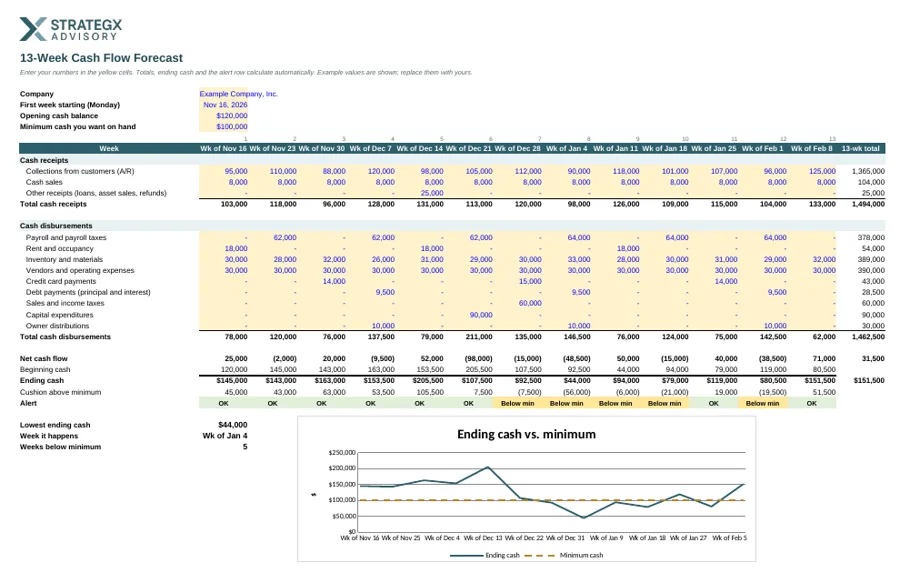
13-week cash flow forecast
The tool CFOs use to see a cash crunch a quarter early. Weekly receipts and disbursements, automatic ending cash, a minimum-cash alert and a chart. Example data included.
Frequently asked questions
How long should a month-end close take?
Small and mid-sized companies can usually close in 10 business days or fewer once the calendar, checklist and reconciliations are in place. Many take much longer before the process is in place.
Do I need new accounting software to close faster?
Rarely at first. Most of the time comes from unclear ownership, missing reconciliations and waiting for invoices. Fix the process before the system.
Should a small business use accrual accounting?
If you have a lender, investors, inventory, or plans to sell, yes. Accrual books show profit in the month it's earned, which is what lenders and buyers use.
Who should review the close?
Someone other than the person who prepared it: a controller, CFO, or an outside reviewer.
Edwin van Stam, CPA, CEPA, CGMA, founded StrategX Advisory in Salt Lake City. He started in audit at Tanner LLC, led accounting and assurance at Cook Martin Poulson, and has spent 20 years in audit, controller and CFO roles and transaction work, advising buyers, sellers and lenders on private-company acquisitions. More about Edwin →
Found this useful? Share it on LinkedIn. This article is general information, not legal, tax, or lending advice, and not an SBA determination.