
What SBA lenders look for in a Quality of Earnings under SOP 50 10 8.1
Since October 1, 2026, every 7(a) acquisition of $3 million or more needs a QoE. Here is the checklist a credit reviewer should run before relying on one, and the red flags that should send it back.

Updated · 3 min read
- The QoE must be independent, prepared for the lender's benefit, and never by or for the seller.
- The QoE reconciles tax returns, IRS transcripts and internal financials, plus accountant-prepared statements where they exist.
- A cash proof is required for the trailing 12 months and the last two fiscal years.
- The report should end in one adjusted earnings figure the underwriter can drop into debt service coverage.
- A buyer's own QoE can't be relied on without a review by one of the lender's vendors.
1. Is the preparer independent, and is the report for the lender?
The SOP requires the QoE to be performed by an independent qualified financial professional and conducted for the benefit of the Lender. It names no required credential, which puts the burden on each lender's vendor policy.
What a reviewer should see in the file:
- An engagement letter addressed to, or naming, the lender as a party that can rely on the work
- A statement that the preparer has no financial interest in the transaction and no recent advisory role with the seller
- A written independence policy you can keep on file. Ours is published here.
Red flag: the seller's CPA or the broker's in-house analyst prepared it, or the fee depends on the deal closing.
2. Do the sources tie out?
Appendix 15 asks for a reconciliation of accountant-prepared financial statements, tax returns, internal financial statements, and IRS transcript data. That doesn't mean the business must have CPA-prepared statements: many Main Street companies don't, and the QoE reconciles the sources that exist. In practice they rarely agree on the first pass. The QoE should show the differences, explain each one, and say which figure it relies on.
| What to check | Why it matters |
|---|---|
| Revenue per tax return vs. internal P&L | Gaps often mean cash sales, timing, or personal income running through the business |
| IRS transcripts vs. returns provided | Confirms the returns in the file are the returns actually filed |
| Year-end accruals and cut-off | Year-end entries can move profit between years on cash-basis books |
| Owner draws vs. W-2 compensation | Drives the owner-compensation adjustment |
3. Is there a real cash proof?
The cash proof independently rebuilds receipts and disbursements from bank statements and reconciles them to the income statement and tax return. The SOP requires it on a trailing 12-month basis and for the last two fiscal years, reduced only if the business is younger than two years.
The SOP doesn't say whether the proof must be monthly or annual; that is left to lender policy. Monthly is the better standard: an annual proof can tie out while hiding a quarter where deposits and reported revenue diverged.
Red flag: a "proof of cash" that only compares year-end bank balances, or one that excludes accounts the owner controls.
4. Is every add-back documented?
Add-backs are where purchase prices are made and lost. The SOP lists the categories it expects documented: non-recurring items, above- or below-market owner compensation, related-party transactions, deferred maintenance, and cash vs. accrual differences.
For each adjustment, a reviewer should be able to find the support (invoice, contract, payroll record), the amount by year, and the reason it won't recur. Adjustments that were proposed but rejected should be shown too, so credit can see the full picture.
The most commonly overstated add-back is owner compensation. We cover it in detail in Owner's salary add-backs: what survives diligence.
5. Will revenue and margins hold after the sale?
Appendix 15 asks for an assessment of revenue quality and sustainability. The report should cover:
- Customer concentration: the share of revenue from the top one, five, and ten customers
- Contract terms and whether key relationships transfer to a new owner
- Pricing and margin trends by month, not just by year
- Dependence on the seller personally for sales, licenses, or key relationships
6. Does it give credit one number to use?
The lender must use the QoE earnings in its debt service coverage determination and keep the report in the credit file. If coverage doesn't support the price and the proposed debt, the loan amount is reduced and more equity fills the gap.
A good report makes this easy: one clearly labeled adjusted earnings figure for DSC, a bridge from reported earnings to that figure, and a sensitivity showing coverage at the proposed debt service. If the report gives both SDE and adjusted EBITDA, it should say which one feeds DSC and why. More on SDE vs. adjusted EBITDA.
7. What if the buyer already has a QoE?
The lender may not rely on a QoE prepared by another party without a review by one of its own vendors. A review is usually faster and cheaper than a new report, and the findings go in the loan file with the original. How our QoE Review works.
8. Was it engaged in time?
For non-delegated (LGPC) submissions the QoE goes in with the application. Under PLP it can be completed after the SBA loan number issues, but a vendor must be retained and an engagement letter in place when the number issues. Build that into your closing checklist; it is an easy item to miss.
Need a QoE on a 7(a) deal?
Engagement letter in one business day, final report in ten. Fixed fees published.
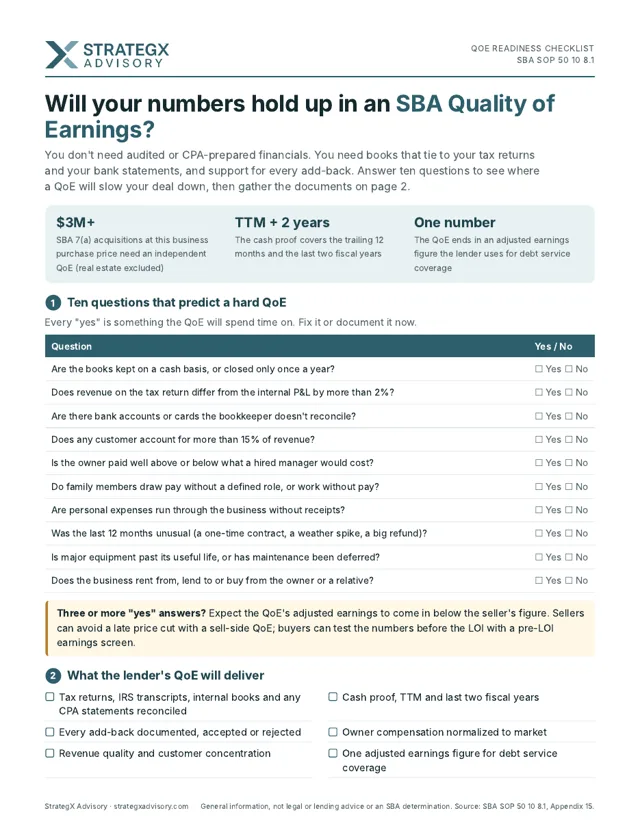
The SBA QoE Readiness Checklist
Two pages: ten questions that show where your numbers won't hold up, the documents a QoE needs (no CPA-prepared financials required), and the timeline. For buyers, sellers and lenders on 7(a) deals of $3M or more.
Frequently asked questions
Does every SBA acquisition loan need a QoE?
No. SOP 50 10 8.1 requires it on 7(a) initial acquisitions and business expansions where the business purchase price is $3 million or more. Owner buyouts and ESOP or cooperative transactions are exempt. Below $3 million, lenders may still ask for one.
Does the QoE preparer need to be a CPA?
The SOP names no required credential. It requires an independent qualified financial professional working for the lender's benefit. Many lenders set their own vendor standards.
Can the lender use a QoE the buyer paid for?
Only after one of the lender's vendors reviews it. The review findings are kept in the loan file with the original report.
Who pays for the QoE?
The SOP allows out-of-pocket due diligence costs to be passed to the borrower. Ask your lender whether borrower-paid report fees can count toward the equity injection.
Edwin van Stam, CPA, CEPA, CGMA, founded StrategX Advisory in Salt Lake City. He started in audit at Tanner LLC, led accounting and assurance at Cook Martin Poulson, and has spent 20 years in audit, controller and CFO roles and transaction work, advising buyers, sellers and lenders on private-company acquisitions. More about Edwin →
Found this useful? Share it on LinkedIn. This article is general information, not legal, tax, or lending advice, and not an SBA determination.