
SDE vs. adjusted EBITDA: which one your lender actually uses
Sellers quote SDE. Lenders and investors underwrite on something closer to adjusted EBITDA. The difference is usually one salary, and it can move a purchase price by hundreds of thousands of dollars.

Updated · 3 min read
- SDE adds back one owner's entire compensation; adjusted EBITDA replaces it with a market salary for running the business.
- SDE fits owner-operated businesses; adjusted EBITDA fits businesses with a manager in place or a non-operating buyer.
- SDE multiples are lower than EBITDA multiples, so mixing the two inflates prices.
- For an SBA loan, what matters is the earnings figure the QoE says supports debt service.
- Owner compensation is the single biggest swing between the two.
The two numbers, in one sentence each
Seller's discretionary earnings (SDE) is pre-tax earnings before interest, depreciation, and amortization, plus non-recurring items, plus the full compensation and perks of one working owner. It answers: how much cash does this business throw off for one owner-operator?
Adjusted EBITDA starts from the same place but replaces the owner's actual pay with what it would cost to hire someone to do the owner's job at market rates. It answers: what does the business earn if the owner just owned it?
A worked example
Here is the same business both ways. The figures are illustrative.
| $000s | Adjusted EBITDA | SDE |
|---|---|---|
| Net income (pass-through, no entity tax) | 300 | 300 |
| + Interest | 40 | 40 |
| + Depreciation and amortization | 60 | 60 |
| + Documented non-recurring items | 30 | 30 |
| + Owner's actual compensation and benefits | 180 | 180 |
| − Market salary for a general manager | (120) | — |
| Earnings | 490 | 610 |
Illustrative. Market salary depends on the role, hours, and local pay data; it is the most negotiated line in most QoEs.
The $120,000 gap is exactly the replacement salary. Apply a multiple to the wrong figure and the price is wrong by that amount times the multiple.
When each one is the right number
- SDE suits small, owner-operated businesses, usually under about $1 million to $2 million of earnings, where the buyer will run the company and take the owner's place.
- Adjusted EBITDA suits businesses with a management layer, or buyers who won't run the company day to day: private equity, family offices, strategic acquirers.
- Multiples follow the metric. Small businesses typically trade at lower multiples of SDE than larger companies do of EBITDA. A seller who applies an EBITDA multiple to SDE double-counts the owner's salary.
What SBA lenders do with it
An SBA lender cares about one thing: can the business service the debt after paying someone to run it? On 7(a) acquisitions of $3 million or more, the lender must use the QoE's earnings in its debt service coverage determination.
Lenders differ in the details. Some start from SDE and subtract the buyer's required living draw; others start from adjusted EBITDA. Either way, a good QoE shows both, states which figure feeds debt service coverage, and explains the owner-compensation adjustment line by line. See the full lender checklist.
What this means if you're selling
- Know which buyer you're selling to. An individual buyer with an SBA loan and a private equity firm will look at different numbers.
- Price your own replacement before a buyer does. Use real local pay data, not a guess.
- Document the add-backs now, while the invoices and contracts are easy to find. Run our free add-back check.
- Consider a sell-side QoE so the buyer's lender accepts your numbers instead of rebuilding them.
Selling or buying a business?
A pre-LOI earnings screen starts at $1,950. A sell-side QoE documents your numbers before a buyer's lender rebuilds them.
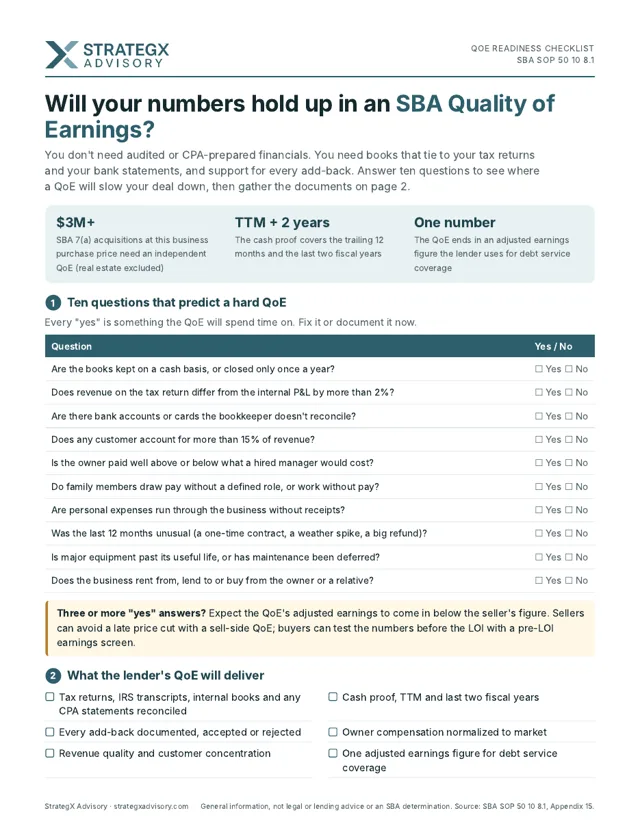
The SBA QoE Readiness Checklist
Two pages: ten questions that show where your numbers won't hold up, the documents a QoE needs (no CPA-prepared financials required), and the timeline. For buyers, sellers and lenders on 7(a) deals of $3M or more.
Frequently asked questions
Is SDE the same as owner's cash flow?
Close. SDE is the pre-tax cash flow available to one working owner before debt service and capital spending. Owner's cash flow is often used to mean the same thing.
Can SDE include two owners' salaries?
Standard practice adds back one working owner. A second owner's pay is normally replaced with a market salary for the work they do, unless the buyer won't need that role filled.
Why is my business valued lower than I expected?
The most common reasons are a multiple applied to the wrong earnings figure, add-backs a buyer won't accept, or an owner salary that has to be replaced at market rates.
Which figure goes into the SBA debt service coverage ratio?
The earnings figure the QoE identifies for debt service coverage. On 7(a) acquisitions of $3 million or more, the SOP requires the lender to use the QoE earnings in that determination.
Edwin van Stam, CPA, CEPA, CGMA, founded StrategX Advisory in Salt Lake City. He started in audit at Tanner LLC, led accounting and assurance at Cook Martin Poulson, and has spent 20 years in audit, controller and CFO roles and transaction work, advising buyers, sellers and lenders on private-company acquisitions. More about Edwin →
Found this useful? Share it on LinkedIn. This article is general information, not legal, tax, or lending advice, and not an SBA determination.