
How to build a 13-week cash flow forecast (with a free template)
The 13-week cash forecast is the single most useful tool a CFO brings to a growing company. Here is how to build one, keep it honest, and use it to make decisions.

Updated · 3 min read
- A 13-week forecast works in weeks and in cash, not monthly profit.
- Start from today's bank balance and the week cash actually moves.
- Set a minimum cash level and watch the weeks that fall below it.
- Update it every Monday: replace last week with actuals and add a new week 13.
- Lenders and boards trust a business that can forecast its own cash.
Why 13 weeks, and why weekly
Thirteen weeks is one quarter: far enough ahead to see a problem while there's time to act, near enough that the numbers are knowable. Weekly matters because cash moves in lumps: payroll every other Friday, rent on the first, a big customer that pays on the 25th. A monthly forecast averages those lumps away; a weekly one shows the Tuesday you can't make payroll.
How to build it
- Start with cash today. The actual bank balance, not the book balance.
- Receipts: forecast collections from your A/R aging by customer, using how fast each one really pays. Add cash sales and one-time inflows.
- Disbursements: payroll and payroll taxes on the days they clear, rent, inventory and materials, vendors, credit cards, debt service, taxes, capital spending and owner distributions.
- Net and roll forward: beginning cash plus receipts minus disbursements gives ending cash, which becomes next week's beginning cash.
- Set a floor: the minimum cash you're comfortable holding, and flag every week below it.
The free template below does steps 4 and 5 automatically, with a chart of ending cash against your minimum.
Common mistakes
- Assuming customers pay on terms. Use actual payment history.
- Forgetting the lumpy items: quarterly taxes, insurance renewals, annual software, three-payroll months.
- Mixing profit and cash. Depreciation isn't cash; loan principal and owner draws are.
- Building it once. A forecast nobody updates is wrong by week three.
The Monday routine
Every Monday, replace last week's forecast with actual receipts and payments, note the biggest variance and why it happened, then add a new week 13. It takes 30 to 60 minutes once the model is set up, and it's the habit that makes the forecast trustworthy. After a few weeks, your variances shrink and your lender starts taking your numbers at face value.
Using it to make decisions
A week below your minimum is a decision, made early: delay a purchase, accelerate collections, adjust an owner distribution, or arrange a line of credit before you need it. Banks lend far more readily to a company that shows them a forecast than to one that calls in a hurry.
If you'd rather not run it yourself, our fractional CFO plans include a 13-week forecast updated weekly.
Want someone to run your cash forecast every week?
Fractional CFO plans from $7,500/mo include a 13-week forecast updated weekly.
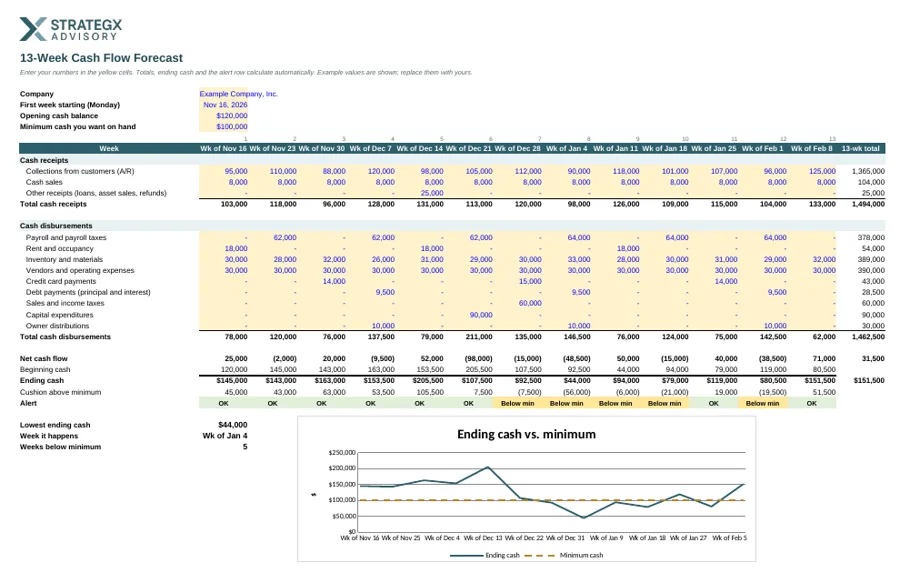
13-week cash flow forecast
The tool CFOs use to see a cash crunch a quarter early. Weekly receipts and disbursements, automatic ending cash, a minimum-cash alert and a chart. Example data included.
Frequently asked questions
What is a 13-week cash flow forecast?
A week-by-week projection of cash receipts and disbursements for the next quarter, starting from today's bank balance, used to spot cash shortfalls early.
How is it different from a budget?
A budget plans monthly profit for the year. A 13-week forecast tracks weekly cash for the next quarter, including items a budget ignores, like loan principal and owner draws.
How often should it be updated?
Weekly. Replace last week with actuals, explain the biggest variance, and add a new week 13.
Is the template free?
Yes. Enter your name and email on this page to download the Excel file. It includes example data, formulas, a minimum-cash alert and a chart.
Edwin van Stam, CPA, CEPA, CGMA, founded StrategX Advisory in Salt Lake City. He started in audit at Tanner LLC, led accounting and assurance at Cook Martin Poulson, and has spent 20 years in audit, controller and CFO roles and transaction work, advising buyers, sellers and lenders on private-company acquisitions. More about Edwin →
Found this useful? Share it on LinkedIn. This article is general information, not legal, tax, or lending advice, and not an SBA determination.