
Interim controller vs. hiring a full-time controller: cost, timing and when each makes sense
Your controller just gave notice, the close is slipping, and the auditors are coming. Here is what interim coverage costs against a permanent hire, and how to use both.

Updated · 3 min read
- A full-time controller costs far more than salary once payroll taxes, benefits and a recruiter's fee are added.
- Interim coverage starts in days; a permanent search usually takes months.
- Part-time interim (two or three days a week) often covers a smaller company's close for less than a full-time hire.
- The best use of an interim is to stabilize the close, then hand off to the right permanent hire.
- Interim makes the most sense for a defined window: a vacancy, a system change, an audit, or a sale.
What each option really costs
Controller base salaries run roughly $115,000 to $185,000 in 2026, and higher at audited, multi-entity companies, according to KORE1's 2026 controller salary guide. Salary is only the start. Payroll taxes and benefits add a meaningful burden on top, and a recruiter's placement fee is commonly charged as a percentage of first-year salary.
| Monthly cost (illustrative) | Full-time hire | Interim, 3 days/week | Interim, full time |
|---|---|---|---|
| Salary or fee | $12,500 | $16,500 | $26,500 |
| Payroll taxes and benefits (about 24%) | $3,000 | — | — |
| Recruiting fee, spread over year one | $2,500 to $3,100 | — | — |
| Notice to end | Severance and a new search | Month to month after 3 months | Month to month after 3 months |
| Time to start | Often months | Days | Days |
Illustrative: a $150,000 base salary; burden estimate based on the employer burden used in KORE1's 2026 contract rate index; recruiting fee assumed at 20% to 25% of first-year salary. Interim figures are StrategX's published fees.
On cost alone, a permanent hire wins once the role is stable and full time. Interim wins when you need someone now, for a defined period, or for fewer than five days a week.
When interim is the better answer
- A sudden vacancy with a close, payroll or audit deadline in the next 30 days
- A system change: a new ERP, a move off QuickBooks, or a messy conversion from cash to accrual
- An audit, a refinancing or a sale, where the books have to stand up to outsiders
- A role that isn't full time yet. Many companies under about $20 million in revenue need two or three days a week of controller work, not five.
- A hire you want to get right. An interim can define the job, clean up the backlog and help interview the permanent controller.
What a good interim controller does in the first 30 days
- Week 1: map the close: who does what, which accounts are reconciled, where the backlog is.
- Week 2: reconcile cash, A/R, A/P and payroll liabilities, and fix what's broken.
- Week 3: publish a close calendar and a checklist with owners and due dates. Here's ours.
- Week 4: deliver the first clean monthly package with variance commentary, and a written plan for the rest of the engagement.
Planning the handoff
Agree up front how the engagement ends: the documented close process, the job description for the permanent role, and two to four weeks of overlap with the new hire. An interim who leaves behind a close calendar, reconciliations and written procedures is worth far more than one who just kept the seat warm.
StrategX's interim coverage is priced by days a week. See current fees or the CFO and controller services page.
Need a controller next week?
Interim coverage from $10,500/mo, two to five days a week, month to month after three months.
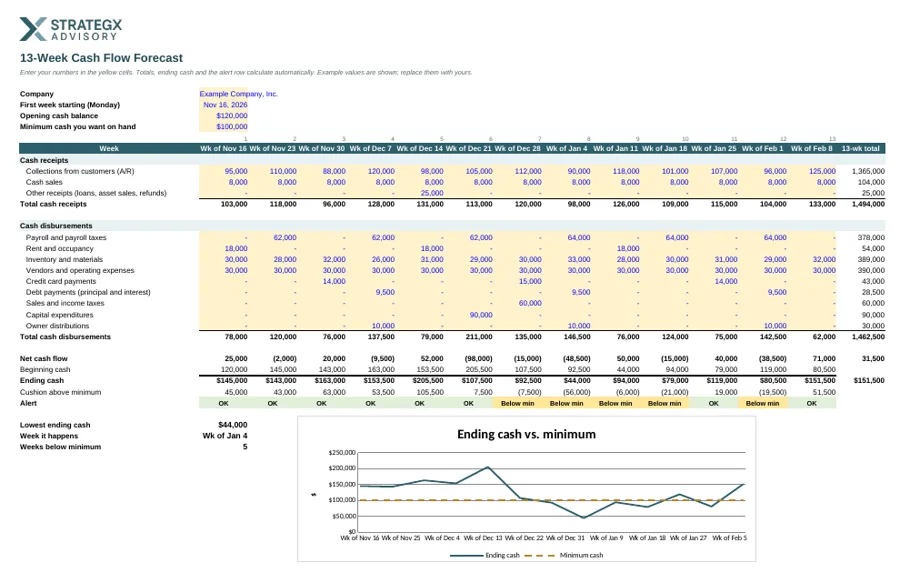
13-week cash flow forecast
The tool CFOs use to see a cash crunch a quarter early. Weekly receipts and disbursements, automatic ending cash, a minimum-cash alert and a chart. Example data included.
Frequently asked questions
How quickly can an interim controller start?
Usually within a week of signing, sometimes sooner. A permanent search through a recruiter commonly takes months from posting to start date.
Is an interim controller cheaper than a full-time hire?
Not per hour. But a part-time interim is often cheaper per month than a full-time hire, and there is no recruiting fee, benefits cost or severance.
Can an interim controller work part time?
Yes. Two or three days a week covers the close at many companies under about $20 million in revenue. StrategX prices interim coverage by days a week.
Can the interim help hire my permanent controller?
Yes, and it's one of the best uses of the engagement: they define the role from the inside, help interview, and train the new hire before handing off.
Edwin van Stam, CPA, CEPA, CGMA, founded StrategX Advisory in Salt Lake City. He started in audit at Tanner LLC, led accounting and assurance at Cook Martin Poulson, and has spent 20 years in audit, controller and CFO roles and transaction work, advising buyers, sellers and lenders on private-company acquisitions. More about Edwin →
Found this useful? Share it on LinkedIn. This article is general information, not legal, tax, or lending advice, and not an SBA determination.