
Owner's salary add-backs: what survives a Quality of Earnings
The add-back that gets cut most often in diligence isn't fraud. It's the owner's own pay. Here's how buyers and lenders rebuild it, and how to support yours before they do.

Updated · 3 min read
- Buyers add back the owner's pay, then subtract what it costs to replace the owner's work at market rates.
- An owner who works two jobs, such as CEO and lead estimator, may need two replacement salaries.
- Family members on payroll are adjusted to market in both directions.
- Personal perks run through the business are accepted only with documentation.
- Below-market owner pay is an adjustment too, and it reduces earnings.
How the adjustment actually works
A Quality of Earnings doesn't simply add back the owner's salary. It removes everything the owner actually took (salary, bonus, payroll taxes, retirement contributions, health insurance, and perks) and then subtracts what it would cost to hire someone to do the owner's job. SOP 50 10 8.1 lists above- or below-market owner compensation as an adjustment a QoE must document.
| Owner compensation adjustment ($000s) | Amount |
|---|---|
| Owner W-2 salary and bonus | 210 |
| Payroll taxes, retirement, and health insurance on owner | 38 |
| Vehicle and phone used personally (documented) | 14 |
| Add back: total owner cost | 262 |
| Less: market salary and burden for a general manager | (145) |
| Net adjustment to earnings | 117 |
Illustrative figures.
What "market salary" means
Market salary is what the buyer would have to pay, with benefits and payroll taxes, to hire someone for the work the owner does today, in that location. Credible sources include government wage data, industry compensation surveys, recruiter quotes, and what comparable local companies actually pay.
Three things push the number up:
- Hours. An owner working 60 hours a week is often doing more than one job.
- Two roles. An owner who is also the top salesperson, estimator, or technician needs that role replaced as well.
- Licenses. A license held personally (contractor, pharmacist, dentist) may need a licensed, and more expensive, replacement.
Family members and other related parties
A spouse on payroll who doesn't work in the business is a valid add-back. A son paid $40,000 to run operations that would cost $85,000 to staff is an adjustment the other way. Diligence normalizes every related party to market: payroll, rent on a building the owner owns, and loans to or from the owner.
Perks and personal expenses
Personal expenses run through the business (vehicles, phones, travel, insurance, club dues) are legitimate add-backs only if they are documented and clearly personal. Expect a buyer to ask for the general ledger detail and to reject round-number estimates. If you plan to sell in the next two years, stop running personal expenses through the company now; clean books are worth more than the add-back.
When the owner is underpaid
Owners who pay themselves little and take distributions instead make reported earnings look higher than they are. A QoE will deduct the shortfall. This catches many S corporation owners by surprise, especially when a lender is sizing a loan on the result.
How to support your owner add-back
- List every role you perform and the hours each takes.
- Price each role using local pay data, and keep the source.
- Pull the payroll records for every owner and family member for three years.
- Tag personal expenses in the general ledger with receipts, or stop running them through the business.
- Get an outside read before you go to market. Start with the free add-back check, or ask about a sell-side QoE.
Thinking about selling in the next two years?
We'll show you which add-backs will hold up and what to fix before a buyer looks.
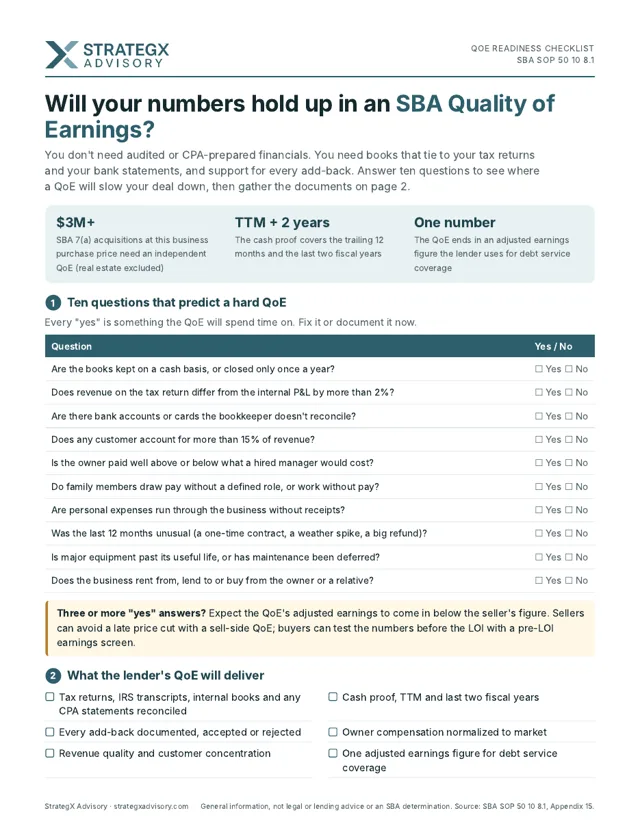
The SBA QoE Readiness Checklist
Two pages: ten questions that show where your numbers won't hold up, the documents a QoE needs (no CPA-prepared financials required), and the timeline. For buyers, sellers and lenders on 7(a) deals of $3M or more.
Frequently asked questions
Can I add back my entire salary when I sell?
For SDE, one working owner's full compensation is added back. For adjusted EBITDA, and for most lender underwriting, a market salary for the owner's role is subtracted again.
Is my health insurance an add-back?
Health insurance and other benefits paid for the owner are part of total owner cost, so they are added back and then replaced by the benefits a hired manager would need.
What if I'm the only person who can do the work?
Buyers and lenders treat that as key-person risk. Expect a higher replacement salary, a longer transition period, or a price adjustment.
Do lenders accept add-backs without receipts?
Generally no. SOP 50 10 8.1 requires the QoE to document all add-backs and adjustments, and lenders follow the QoE.
Edwin van Stam, CPA, CEPA, CGMA, founded StrategX Advisory in Salt Lake City. He started in audit at Tanner LLC, led accounting and assurance at Cook Martin Poulson, and has spent 20 years in audit, controller and CFO roles and transaction work, advising buyers, sellers and lenders on private-company acquisitions. More about Edwin →
Found this useful? Share it on LinkedIn. This article is general information, not legal, tax, or lending advice, and not an SBA determination.