
Worked example: how a Quality of Earnings can reshape a $5.5 million landscaping acquisition
An illustrative SBA 7(a) deal: the seller's numbers supported the price, the QoE didn't, and the buyer closed anyway on better terms. Here is what changed and why.

Updated · 3 min read
- Seller-presented adjusted EBITDA of $1.25M fell to $920K after four QoE adjustments.
- At the original $5.5M price, debt service coverage dropped from 1.56x to 1.15x, below the lender's 1.25x policy minimum.
- The deal closed at $4.5M with a $400K seller note on full standby, and coverage of 1.56x.
- Snow revenue and owner replacement cost were the two biggest adjustments.
- Every figure here is illustrative, built from patterns common in landscaping QoEs, not from any client.
About this example
The situation
A first-time buyer agreed to acquire a commercial landscaping company in the Mountain West for $5.5 million: 4.4 times the seller's adjusted EBITDA of $1.25 million. The company served office parks, HOAs and retail centers with maintenance contracts, enhancements and winter snow removal. The buyer planned to finance the deal with an SBA 7(a) loan and a 10% equity injection.
Because the business purchase price was above $3 million, SOP 50 10 8.1 required a Quality of Earnings performed for the lender's benefit. The lender engaged the QoE when the loan number issued, with the report due before closing.
What the QoE found
The reconciliation of tax returns, transcripts and internal books tied out, and the monthly cash proof showed deposits matching reported revenue within 1%. The add-backs and normalizations were another story:
| Adjustment ($000s, trailing 12 months) | Seller | QoE |
|---|---|---|
| Seller-presented adjusted EBITDA | 1,250 | 1,250 |
| Owner compensation: full $240K added back; market general manager costs $150K with burden | — | (150) |
| Snow removal: the trailing year's snow profit was well above the five-year average; normalized to the average | — | (110) |
| Revenue cut-off: spring cleanup contracts billed in advance were booked as revenue when billed | — | (45) |
| Personal expenses: $60K claimed, $35K documented; undocumented portion reversed | — | (25) |
| Adjusted EBITDA | 1,250 | 920 |
Illustrative figures.
The QoE also flagged about $300,000 of mowers, trucks and trailers past their useful lives. That isn't an EBITDA adjustment, but it is cash the buyer would spend in year one, so the lender factored a capital expenditure reserve into its review.
What it did to the deal
The lender sizes the loan on the QoE earnings. On the original structure, coverage no longer worked:
| Structure | Original | Restructured |
|---|---|---|
| Purchase price | $5,500K | $4,500K |
| Buyer equity (10%) | $550K | $450K |
| Seller note on full standby | — | $400K |
| SBA 7(a) loan | $4,950K | $3,650K |
| Annual debt service (10-year term, 10.5% assumed) | $802K | $591K |
| DSC on seller's $1,250K | 1.56x | — |
| DSC on QoE's $920K | 1.15x | 1.56x |
Illustrative. Debt service is principal and interest on the SBA loan only; the standby note carries no payments during the loan term in this example. Lenders' coverage minimums vary. The original loan is kept under the $5 million SBA 7(a) maximum.
At 1.15x the loan would not pass the lender's 1.25x policy minimum. Rather than walk away, the buyer used the QoE to renegotiate: a $4.5 million price, about 4.9 times QoE adjusted EBITDA, with $400,000 of it as a seller note on full standby. Coverage on the new structure was a comfortable 1.56x.
Why the seller accepted
Each adjustment was documented line by line: payroll records for the owner's role, five years of snow invoices and weather data, the contract billing schedule, and the general ledger detail behind every personal expense. With the numbers in front of them, the seller's broker agreed the original price relied on a record snow year and on adding back a salary the buyer would have to pay someone else.
A seller who had commissioned a sell-side QoE a year earlier would have found the same four issues and priced the business correctly from the start, without a renegotiation weeks before closing.
Lessons for buyers, sellers and lenders
- Normalize weather. Snow, storm cleanup and drought-driven irrigation work swing year to year. Use a multi-year average. More on this in our landscaping QoE guide.
- Price the owner's replacement before a buyer does. How owner salary add-backs work.
- Watch billing cut-off on prepaid and seasonal contracts; deferred revenue is a liability, not this year's profit.
- Look past EBITDA to capex. Old equipment is a real cost even when it isn't an add-back.
- Sellers: get a QoE first. It is cheaper to fix the story a year out than to renegotiate at the closing table.
Buying or selling a landscaping company?
A pre-LOI earnings screen starts at $1,950. A sell-side QoE finds these issues before a buyer does.
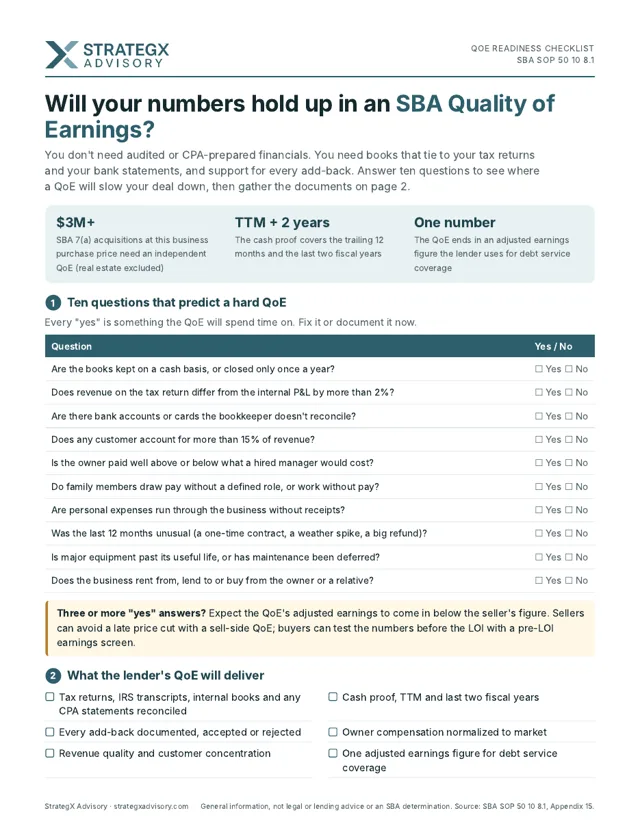
The SBA QoE Readiness Checklist
Two pages: ten questions that show where your numbers won't hold up, the documents a QoE needs (no CPA-prepared financials required), and the timeline. For buyers, sellers and lenders on 7(a) deals of $3M or more.
Frequently asked questions
Is this a real client?
No. It is an illustrative composite built from issues common in landscaping and field-services QoEs. The company, figures and terms are invented.
Why did the QoE lower EBITDA so much?
Two items drove most of it: a record snow year normalized to a five-year average, and the owner's salary replaced at what a hired general manager would cost.
Could the buyer have closed at the original price?
Not on this financing. The SBA lender must use the QoE earnings for debt service coverage, and 1.15x was below its 1.25x policy minimum, so the loan would have been reduced.
What does a landscaping QoE cost?
Our published fees start at $11,500 for deals under $3 million and $14,500 for $4 million to $5 million; landscaping deals under $1.5 million can use the $7,500 Main Street QoE. See the pricing page for the full schedule.
Edwin van Stam, CPA, CEPA, CGMA, founded StrategX Advisory in Salt Lake City. He started in audit at Tanner LLC, led accounting and assurance at Cook Martin Poulson, and has spent 20 years in audit, controller and CFO roles and transaction work, advising buyers, sellers and lenders on private-company acquisitions. More about Edwin →
Found this useful? Share it on LinkedIn. This article is general information, not legal, tax, or lending advice, and not an SBA determination.