
Buy-side vs. sell-side Quality of Earnings: which one do you need?
Both test the same earnings with the same procedures. What changes is who the report works for, when it happens, and what each side does with it.

Updated · 3 min read
- A buy-side QoE is commissioned by the buyer, or its lender, to test the seller's numbers before closing.
- A sell-side QoE is commissioned by the owner before going to market, to find and fix issues first.
- The procedures are largely the same: the difference is timing, audience and what happens with the findings.
- A sell-side QoE rarely replaces the buyer's own diligence, but it shortens it and protects the price.
- Private equity, strategic and individual buyers all run QoEs; an SBA loan of $3M or more requires one.
The short answer
| Buy-side QoE | Sell-side QoE | |
|---|---|---|
| Who commissions it | Buyer, investor or lender | Business owner or their banker |
| When | After the LOI, before closing | Six to twelve months before going to market |
| Purpose | Confirm the earnings the price is based on | Find and fix what a buyer would challenge |
| Who sees it | Buyer, its lender and investors | The owner first; buyers later, if shared |
| Typical result | Price, terms or loan size adjusted | A defensible earnings number and fewer surprises |
Buy-side: testing what you're paying for
Private equity firms, independent sponsors, search funds, strategic acquirers and individual buyers all commission QoEs to confirm the seller's adjusted EBITDA before closing. The work tests the add-backs, rebuilds revenue and cash, checks customer concentration, and often sets the net working capital target. Lenders, whether SBA or conventional, frequently rely on it to size the loan.
Buyers who want a read before signing a letter of intent can start smaller: a pre-LOI earnings screen tests the headline add-backs in about a week.
Sell-side: fixing the story before buyers read it
A sell-side QoE runs the same tests from the owner's side, early enough to act on the findings: clean up cut-off, document add-backs, normalize owner pay, and decide how to present one-time items. Owners and their bankers then go to market with a number that holds up, instead of discovering the issues during the buyer's diligence, when the only fix is a lower price.
It also speeds the buyer's diligence. Buyers and lenders usually still run their own work, but much faster when the support is already organized. See our sell-side QoE and readiness service.
What each costs
The hours are similar, so our fees are the same by deal size: from $11,500 for deals under $3 million to $19,500 for $5 million to $10 million, with sell-side starting at $9,000 under $3 million. Lower middle market and private equity add-on work typically runs $25,000 to $70,000, depending on revenue, entities, inventory and report format. All published fees.
Which one should you get?
- You're buying: a buy-side QoE, or a pre-LOI screen first if you're still negotiating.
- You're selling in the next year: a sell-side QoE, early enough to fix what it finds.
- You're selling to a buyer using an SBA 7(a) loan of $3M or more: the lender will require its own QoE; a sell-side QoE prepares you for it. The rule explained.
- You're a lender: engage your own, or have a buyer's report reviewed.
Buying or selling a business?
Fixed fees, published. Full reports in ten business days.
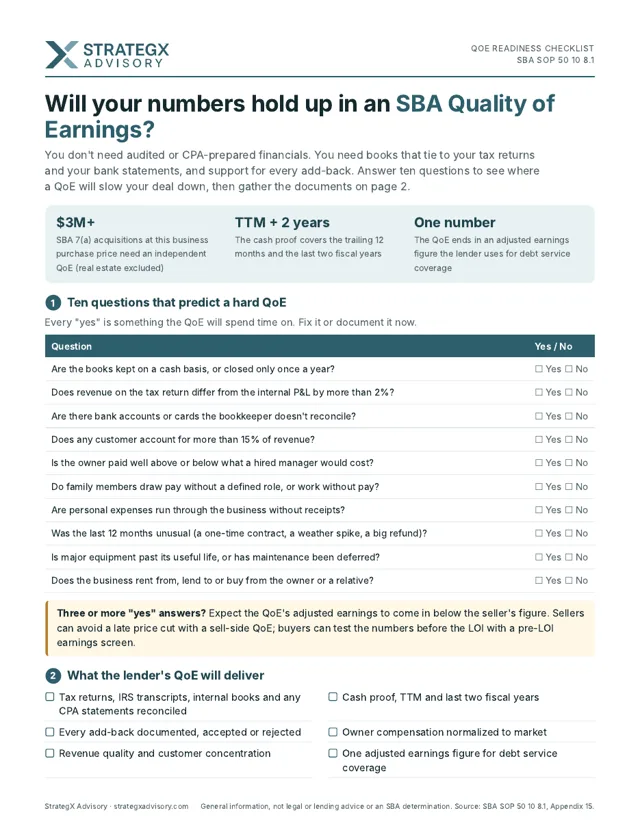
The SBA QoE Readiness Checklist
Two pages: ten questions that show where your numbers won't hold up, the documents a QoE needs (no CPA-prepared financials required), and the timeline. For buyers, sellers and lenders on 7(a) deals of $3M or more.
Frequently asked questions
Does a sell-side QoE replace the buyer's QoE?
Usually not. Buyers and lenders generally run their own diligence, but a well-supported sell-side report makes it faster and leaves less room to renegotiate.
Who pays for a buy-side QoE?
The buyer, in most deals. On SBA loans the cost can be passed to the borrower; ask your lender whether borrower-paid report fees can count toward the equity injection.
How long does a QoE take?
Our full-scope reports take 10 business days from complete data and the first management interview; larger deals are scoped and can take longer.
Is a QoE the same as an audit?
No. An audit gives an opinion on historical financial statements. A QoE is a consulting engagement that tests whether earnings are recurring and sustainable for a transaction.
Edwin van Stam, CPA, CEPA, CGMA, founded StrategX Advisory in Salt Lake City. He started in audit at Tanner LLC, led accounting and assurance at Cook Martin Poulson, and has spent 20 years in audit, controller and CFO roles and transaction work, advising buyers, sellers and lenders on private-company acquisitions. More about Edwin →
Found this useful? Share it on LinkedIn. This article is general information, not legal, tax, or lending advice, and not an SBA determination.
Keep reading
See both in full: an illustrative SBA 8.1 lender QoE and an illustrative sell-side QoE, each with its Excel databook.