
Quality of Earnings vs. audit: what's the difference, and do you need both?
An audit asks whether last year's financial statements are fairly presented. A Quality of Earnings asks whether the earnings a buyer is paying for are real and will continue. They answer different questions.

Updated · 3 min read
- An audit gives an opinion on historical financial statements under accounting standards.
- A QoE tests whether adjusted earnings are accurate, recurring and sustainable for a specific transaction.
- A QoE doesn't require audited or CPA-prepared statements; it works from tax returns, the ledger and bank records.
- Audited companies still get a QoE, because an audit doesn't test add-backs, run-rate earnings or working capital for a deal.
- A QoE is a consulting engagement, not an attest engagement, and gives no audit opinion.
Side by side
| Audit | Quality of Earnings | |
|---|---|---|
| Question answered | Are the financial statements fairly presented under GAAP? | Are the earnings the buyer is paying for real, recurring and sustainable? |
| Who it's for | Owners, boards, lenders, investors, regulators | Buyers, sellers, lenders and investors in a transaction |
| Output | An opinion on the financial statements | Adjusted EBITDA or SDE bridge, working capital analysis, debt-like items, issues list |
| Adjustments | Corrects misstatements to GAAP | Normalizes owner pay, one-time items, related parties and run-rate changes |
| Period | A fiscal year, already closed | Usually trailing twelve months plus two prior years, monthly |
| Standards | Auditing standards; licensed CPA firm required | Consulting engagement; no attest opinion |
| Timing | Weeks to months after year-end | Typically two to four weeks, tied to the deal |
Why audited companies still get a QoE
An audit confirms that the statements follow accounting standards. It doesn't ask whether a $90,000 owner's salary should be added back, whether a large customer is about to leave, whether last year's margins were inflated by a one-time contract, or what level of working capital the business needs to run. Those are the questions that set a purchase price and a loan amount, so buyers and lenders want a QoE either way.
You don't need an audit to get a QoE
Most small and mid-sized businesses have no audited or reviewed statements, and that's fine. A QoE starts from what exists: tax returns, the general ledger, bank statements, payroll records and invoices. It reconciles them to each other with a proof of cash and tests every add-back. Under SBA SOP 50 10 8.1, acquisitions of $3 million or more need a QoE, not an audit. See the SBA QoE requirement.
Where reviews, compilations and valuations fit
- Review: limited assurance on financial statements, less work than an audit. Still about GAAP presentation, not deal earnings.
- Compilation: financial statements prepared by a CPA with no assurance.
- Business valuation: an appraiser's opinion of value. It relies on an earnings figure; a QoE is how you know that figure holds up.
- Quality of Earnings: the diligence that tests the earnings for the deal.
StrategX performs Quality of Earnings and other consulting work. We don't perform audits, reviews or compilations; our independence policy explains how we stay objective.
Which one do you need?
- Buying or financing an acquisition: a buy-side or lender QoE.
- Selling in the next year or two: a sell-side QoE, so the buyer's diligence finds nothing new.
- Your lender's covenant or an investor requires audited statements: an audit from a licensed CPA firm. We can get you ready for a first audit.
Need a QoE, not an audit?
Fixed fees, CPA-led, full reports in ten business days.
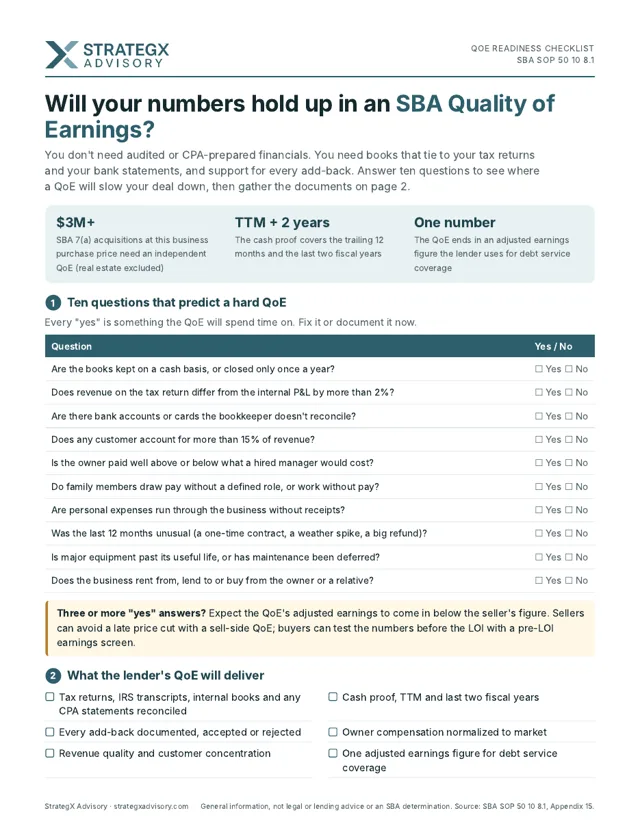
The SBA QoE Readiness Checklist
Two pages: ten questions that show where your numbers won't hold up, the documents a QoE needs (no CPA-prepared financials required), and the timeline. For buyers, sellers and lenders on 7(a) deals of $3M or more.
Frequently asked questions
Is a Quality of Earnings report an audit?
No. A QoE is a consulting engagement that tests earnings for a transaction. It gives no audit opinion and doesn't require audited statements.
Which is more expensive, an audit or a QoE?
It depends on size and scope. Our QoE fees start at $11,500 for buy-side deals under $3 million; audit fees vary widely by firm and company size and recur every year.
Can my auditor do my QoE?
Many audit firms also do transaction work, but independence rules can limit what your own auditor can do for you, and buyers often prefer a separate firm.
Does an SBA loan require an audit?
No. Under SOP 50 10 8.1, SBA 7(a) acquisitions of $3 million or more require a Quality of Earnings, not an audit. Lenders may ask for other financial statements.
Does a QoE replace due diligence?
It covers the financial part. Buyers usually also do legal, tax, operational and sometimes IT or environmental diligence.
Edwin van Stam, CPA, CEPA, CGMA, founded StrategX Advisory in Salt Lake City. He started in audit at Tanner LLC, led accounting and assurance at Cook Martin Poulson, and has spent 20 years in audit, controller and CFO roles and transaction work, advising buyers, sellers and lenders on private-company acquisitions. More about Edwin →
Found this useful? Share it on LinkedIn. This article is general information, not legal, tax, or lending advice, and not an SBA determination.